Study facts at a glance
Named US formulation: TRI-LUMA is a topical combination of fluocinolone acetonide 0.01%, hydroquinone 4% and tretinoin 0.05%. These values identify the product. Source 1
Different records: A clinical comparison does not establish US approval or current availability for the research generic. Source 3 Source 1 Source 2
Counting rule: A proportion of people meeting a severity-change threshold is not a percentage of pigment removed. Source 3 Source 1
Label boundary: The US indication concerns short-term treatment of moderate-to-severe facial melasma with sun avoidance and sunscreen, not maintenance. Source 1
Commercial interpretation: A study result cannot verify a provider’s current formulation, dispensing arrangements or price. Those require separate records. Source 3 Source 1
Decide which record must support the statement
Before comparing products, separate three statements that can sound deceptively similar: a treatment was studied, a particular product has approved labeling, and a particular product is currently offered. Each statement needs evidence suited to its purpose. A trial report can describe the first without documenting the second or third. An offer page can describe the third without establishing the clinical result being claimed.
This separation changes how a reader investigates an apparently simple sentence about a cream. If the sentence concerns treatment success, the relevant details include the endpoint and study population. If it concerns an approved indication, the product label matters. If it concerns a current transaction, a historical research report cannot establish the present dispensing terms. Combining those statements would leave the reader unable to tell which part was actually checked.
The guide to hydroquinone approval claims develops this product-specific distinction. For this article, the scientific task is to maintain a clear connection between the claim and its supporting record. The origin of the research is part of its context, but the validity of a particular inference depends on what was measured and documented, not on whether a product name looks familiar.
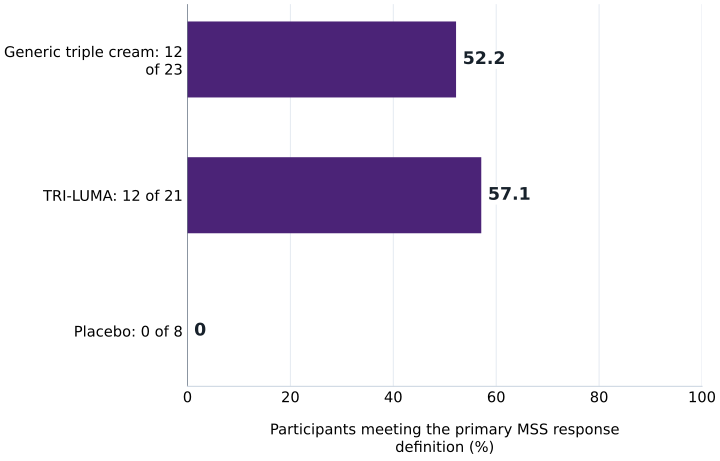
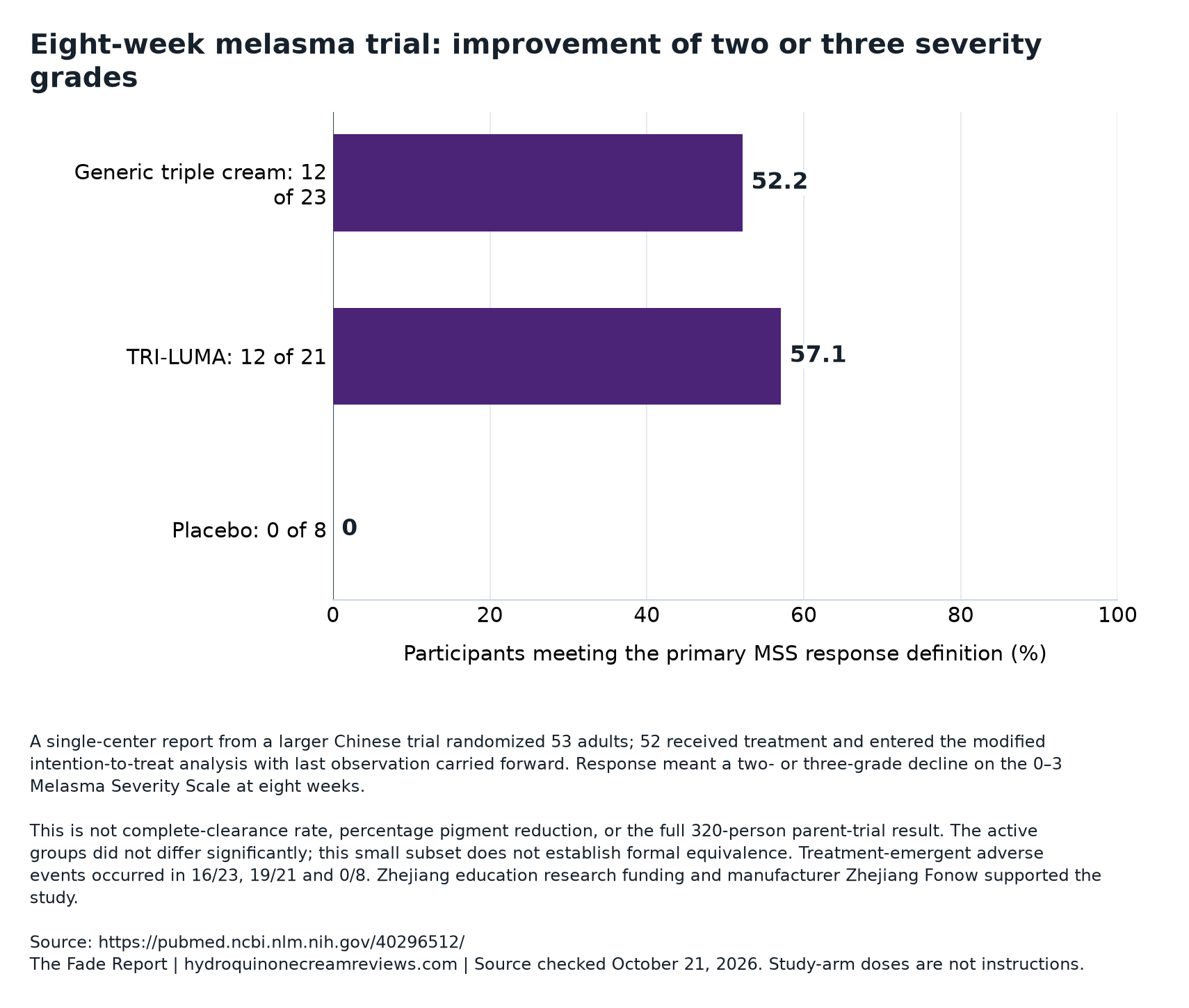
Read the underlying chart data: download CSV or download the source-labeled chart.
Keep the studied population visible when reading across jurisdictions
The randomized, double-blind Chinese single-center report enrolled 53 participants, allocated 24/21/8 to generic cream, TRI-LUMA and placebo. Most were women with epidermal melasma, aged 33–55.
Moving from a study population to another population is an inference about applicability. It is different from identifying a product’s regulatory status. The first asks whether the observed comparison is informative for another setting; the second asks what an authoritative product record establishes. Neither question can be resolved simply by saying that the same condition occurs in both places.
A useful applicability assessment would compare diagnostic criteria, starting severity, relevant participant characteristics and treatment conditions. Those factors describe the circumstances under which the observation was made. A country label is much less specific. It would be inappropriate to assume identical outcomes everywhere, but equally inappropriate to infer that a result must differ because participants were recruited elsewhere. To establish a difference between populations, research would need a comparison capable of evaluating that difference. This report’s geographic setting therefore supplies context for judgment, not a numerical adjustment to apply to its response rates. No race-based prediction for an individual follows from the study’s location.
Match a product identity before matching a clinical claim
The labeled formulation provides a concrete reference point, but matching one ingredient is not equivalent to matching that reference. A full identity includes the active ingredients and strengths, the dosage form and the particular product being described. The guide to hydroquinone, tretinoin and steroid combinations helps organize those distinctions without treating a concentration as a stand-alone treatment choice.
Consider an illustrative search result that uses a familiar ingredient name in its title but does not identify the complete preparation. It may be relevant to an ingredient search while remaining insufficient to support a product-specific conclusion. Another document might identify a complete preparation but say nothing about whether it is presently supplied in the reader’s location. These are different missing facts. Filling one gap would not automatically fill the other.
Product identity also keeps document dates in perspective. The date a website was checked, the date a label was revised and the dates of clinical observations describe different events. A recently accessed page does not make an older experiment newly conducted. Conversely, an older trial can remain relevant to a current label when its relationship to the named product and outcome is accurately described.
Put the two success definitions beside their own denominators
The table presents the primary outcomes as separate records. Its endpoint column is necessary to interpret the numbers: the Chinese response rule measures a change in severity, whereas the label trials count a defined final state. The label’s studies compared three dual-active combinations rather than placebo.
A percentage becomes meaningful only after specifying the event in its numerator and the people in its denominator. Changing the event can change the percentage even when the underlying clinical experience has not changed. For example, in a purely illustrative group, some people might achieve substantial improvement without reaching a clearing threshold. They could qualify under one rule but not the other. That is a difference in classification, not evidence that one set of observations is wrong.
It follows that the table is unsuitable for ranking a generic against TRI-LUMA across separate trials. Such a ranking would attribute every difference to the product while ignoring the outcome rule and study context. The clinical-results explainer examines this reading problem. Keeping the original denominators and endpoint names attached to their percentages is a practical way to prevent a comparison from becoming more ambitious than the evidence.
Eight-week participant outcomes. MSS means Melasma Severity Scale (0–3). Response requires a decline of 2 or 3 grades; clearing requires MSS zero. Fractions show participants meeting the endpoint / analyzed.
| Treatment record | Defined endpoint | Participants / analyzed (%) |
|---|---|---|
| Chinese study: generic combination | Response | 12/23 (52.2%) |
| Chinese study: TRI-LUMA | Response | 12/21 (57.1%) |
| Chinese study: placebo | Response | 0/8 (0%) |
| US label trial 1: TRI-LUMA | Clearing | 32/85 (38%) |
| US label trial 2: TRI-LUMA | Clearing | 10/76 (13%) |
Ask which observations entered the estimate
One untreated participant was excluded; the Chinese analysis included 52, using last observations for missing scores. Forty-four completed (18/19/7 by arm).
The analysis population and the participants with complete follow-up are not interchangeable descriptions. One describes whose information contributes to an estimate under the chosen method; the other describes completion. A result calculated using a rule for incomplete observations should be interpreted with that rule visible. Otherwise, the table can appear to represent a complete set of final examinations when some values were handled differently.
For an illustrative missing-data exercise, imagine an early score followed by no final visit. Several later outcomes remain possible. An analysis must decide how that incomplete record contributes, while the reader should ask whether a different plausible handling could change the conclusion. A larger-looking denominator does not resolve the unobserved outcome. Nor does removing every incomplete record necessarily improve the answer, since the reasons for missingness could be relevant. The review-reading guide offers a related perspective on selected images and testimonials: the records that are visible may not describe all the experiences relevant to a decision. Here, the published analysis method is more informative than assuming every enrolled person supplied the same observations.
Separate uncertainty about effect from a claim about approval
Active-arm efficacy differences were nonsignificant; the Chinese subset did not establish formal equivalence. All arms received cleanser, moisturizer and sunscreen.
There are two distinct reasoning steps to resist. First, failure to detect a difference does not show that every meaningful difference has been excluded. That would require a suitable comparison criterion and adequate precision. A confidence interval would help express uncertainty around an estimate; a conclusion about equivalence additionally needs a justified margin. The word similar cannot supply those missing requirements.
Second, even a stronger clinical comparison would still need to be connected to the exact regulatory statement someone wants to make. Scientific evidence and a documented product status are related but different categories of information. Neither an ingredient match nor a study’s favorable interpretation establishes US approval for its research generic. As an editorial application, the CoreAge Rx review can be used to examine recorded offer terms. It should not be read as evidence that the service supplies the trial product or delivers the trial response. The treatment conditions and present commercial facts need their own verification before a result is applied to that particular offer.
Read safety through both the observed events and the label
Adverse events affected 16/23 generic, 19/21 TRI-LUMA and 0/8 placebo participants; active-arm totals did not differ significantly. One TRI-LUMA participant withdrew with exfoliation. No atrophy or telangiectasia was observed over eight weeks.
The label identifies sulfite hypersensitivity, ochronosis, systemic corticosteroid effects and local irritation; pregnancy needs clinician discussion. Safety and efficacy were not established for phototypes V–VI or other hyperpigmentation conditions.
Observed events and labeled warnings perform complementary roles. A trial supplies a defined group and observation period; a warning identifies a concern that cannot be dismissed because it was absent from a small, brief comparison. Reading both avoids turning a limited event count into a general reassurance. It also avoids treating every listed warning as though the study measured its frequency. The sulfite-and-allergy label guide illustrates why the complete product record matters beyond the headline active ingredient. When considering safety, ask which event was tracked, how it was defined, when it could be observed and whether it affected participation. Those questions are more informative than applying one broad safety adjective to all components, treatment periods and people.
Use the regulatory notice without extending it to an unverified product
FDA states that no over-the-counter skin-lightening products are FDA-approved or legally marketed. It reports hydroquinone-associated rashes, swelling and potentially permanent ochronosis.
The notice should be read within that category. It is not a substitute for checking the named prescription product, and it does not determine the status of every preparation described on a provider website. A similar ingredient name cannot turn a general notice into a finding about an individual product that was not evaluated in the record being cited. Equally, the existence of one approved combination does not grant that identity to another formulation.
The table offers an editorial method for keeping these inquiries separate. It does not certify any commercial product. The Nurx hydroquinone review can help locate documented service and charge terms for scrutiny; the trial discussed here does not verify those terms or that service’s outcomes. Scientific interpretation improves when each question has a corresponding record instead of asking a single document to answer all of them. An unresolved identity, availability or prescribing question should remain unresolved until the relevant information is obtained, rather than being filled by an unrelated positive trial result.
An editorial guide to matching a claim with its supporting record; these are documentary questions, not clinical outcome estimates.
| Claim being checked | Record needed for that question | What would not settle it |
|---|---|---|
| A treatment produced a specified response | The original comparison and endpoint definition | A current price or promotional description |
| A named US product has a specified indication | The exact product’s authoritative labeling | An ingredient shared with another cream |
| A preparation is currently supplied through a service | Current documentation identifying the preparation and terms | A historical trial conducted elsewhere |
Recognize when a related study measures another outcome
A separate five-month randomized sunscreen study involved 42 women; 41 completed. Colorimetry was primary, and clinical mMASI was secondary. Both sunscreen groups improved clinically without a significant between-group mMASI difference.
This neighboring evidence is useful because it exposes another possible translation error. An instrument can measure color characteristics while a clinical score evaluates severity. Neither result automatically supplies the event counted in a clearing trial. The shared subject of melasma does not make the units interchangeable. Combining measurements requires a stated interpretation, not merely putting them under the same condition heading.
The tinted-sunscreen study analysis examines that difference in detail. Here, its lesson concerns the boundaries between evidence records: a study with a different intervention and measurement system cannot extend a cream trial’s endpoint or establish the status of a cream. A useful synthesis can identify complementary findings while keeping their questions separate. For example, it may point to a need to evaluate both clinical appearance and instrumental measurements in future research. It cannot infer that every intervention affecting one measure necessarily produces the same change in the other, or that their results form one combined estimate of treatment success.
Check disclosures while keeping conclusions proportional
Zhejiang education funding and manufacturer Fonow supported the cream study; Fonow supplied products. Authors declared no conflicts. NAOS funded the sunscreen study; three authors were current or former employees, and industry honoraria were disclosed.
These relationships are part of the research record. They do not replace an assessment of the comparison, but they help readers understand who supported the work and why independent examination of the methods matters. A financial relationship should not be guessed from a brand name, nor should a documented relationship be omitted when interpreting a publication’s claims.
A proportionate conclusion follows the shortest supported route from observations to statement. Identify the analyzed group, retain the outcome definition, examine uncertainty and limit the conclusion to the tested comparison. Only then ask whether another record supports the proposed product-status or commercial claim. When those steps lead to different answers, the disagreement may reflect different questions rather than contradictory evidence. This approach leaves room for a trial to be scientifically informative without turning it into an approval document or a purchasing guarantee. It also makes the remaining research needs concrete: a better comparison, more precise estimates, broader applicability evidence or current product documentation, depending on the claim.
Source 3 Source 4 Source 1 Source 2
Questions about the evidence
Does the term generic in the research report mean a US-approved generic is available?
That conclusion does not follow from the clinical report. A name used to describe a study treatment and a current US product status are different kinds of information. To establish approval or availability, the exact product would need to be identified in the relevant current record. The result remains evidence about the study assignment even when those separate facts are not established.
Can I compare the Chinese response percentage directly with the label’s clearing percentage?
The event being counted must match before those numbers can be compared as though they answer one question. A severity improvement and a final clearing state classify outcomes differently. Retaining the endpoint definitions lets the records be discussed together without converting them into a head-to-head product ranking that neither experiment supplied.
Is overseas evidence irrelevant to someone reading a US prescription label?
No. It can contribute information about a studied comparison while raising questions about applicability. The useful task is to identify which characteristics and treatment conditions matter for the proposed inference. Neither automatic acceptance nor automatic rejection follows from geography alone. Product identity and regulatory status still need their own documentary checks.
Does a safety warning tell me how likely that harm is for me?
A warning identifies a concern; it does not necessarily provide an individual probability. A study event rate also depends on the population, event definition and observation period. An individual assessment needs relevant circumstances beyond those group summaries. Reading the warnings and study observations together helps prepare that discussion without turning either into a personal risk calculator.
What is the most useful way to read a provider claim alongside this research?
Break the claim into parts: which preparation is described, which clinical effect is asserted and which current service facts are promised. Check the evidence appropriate to each part. A provider’s documentary terms can be examined without assigning it a trial result, while a trial can be interpreted without assuming that the study treatment is what a particular service supplies.
What this evidence supports
The Chinese treatment comparison, the US TRI-LUMA label and a present-day offer should remain identifiable records throughout a review. Their relationship becomes useful when the same product identity and the same clinical question are genuinely supported, rather than assumed from overlapping names. The trial table illustrates why the endpoint travels with the percentage: a number detached from its counting rule can appear more general than the result actually is. Our interpretation for The Fade Report is to evaluate the clinical evidence and the product-status evidence in parallel, then make only the connection that both support. That permits a measured treatment response to inform understanding while leaving US availability, a particular compounded preparation and provider-specific outcomes to the distinct records needed to establish them.
Research access and limitations
The full Chinese report, official US label, full sunscreen research letter with its verified funding footnote, and current FDA notice were consulted. The sunscreen supporting-information document and values inferred from its figures were not reviewed. No US approval, availability, price or provider outcome is established for the research generic. This analysis does not prescribe a formulation or personal treatment schedule.