Study facts at a glance
Allocation: 42 women randomized; 21 per group. Source 4
Setting: Five months in southern France during summer. Source 4
Primary endpoint: Instrumental colorimetry. Source 4
Completion: 41 completed; one pregnancy withdrawal; final arm counts unreported. Source 4
Study funder: NAOS Ecobiology Company. Source 4
Begin with the question each record was created to answer
A scientific result becomes easier to interpret when its documentary purpose is explicit. A trial can evaluate a defined comparison in a defined population. A prescription label can identify the medicine and the conditions attached to its indicated use. A regulatory notice can describe a safety or approval concern. Those functions overlap in subject matter without becoming substitutes for one another.
The table is an editorial reading framework, not a description of extra research. It shows why finding a familiar ingredient in several documents does not resolve every question about a finished product. The experiment’s outcome still needs interpretation, while product identity and regulatory claims need the appropriate record. A credible explanation should tell the reader which source supports each kind of statement.
Our guide to checking an FDA-approval claim develops the product-specific reading task. Here, the scientific priority is to avoid importing an answer from the wrong document. A positive study observation cannot supply missing regulatory evidence. Equally, a labeled indication does not establish how two unrelated commercial offers compare on a particular clinical endpoint. The useful connection is traceable support for a specific question, rather than a general impression of scientific authority.
Editorial framework for reading different evidence records. The functions below are not additional trial findings.
| Record | Question it helps answer | Separate question that remains |
|---|---|---|
| Research report | What was observed under the study conditions? | Does this identify the product in a current offer? |
| Prescription labeling | What medicine, indicated use and precautions are documented? | How does an unstudied alternative perform? |
| Regulatory notice | What approval or safety concern is addressed? | What is established about a particular untested preparation? |
Source 4 Source 3 Source 1 Source 2
Read the underlying chart data: download CSV or download the source-labeled chart.
Retain the identity of the preparations actually studied
The tinted preparation was Bioderma Photoderm M SPF50+ Golden, with visible-light protection factor pVL 66; its untinted comparator provided similar UV protection. This description identifies a particular comparison. It should travel with the result whenever that result is discussed, rather than being shortened to a claim about every product described as tinted or untinted.
A product characteristic and a clinical outcome have different meanings. A protection factor describes a measured property under its testing framework. A clinical assessment observes a condition in people. Connecting those records requires evidence rather than a conversion of one number into the other. The fact that both concern pigmentation does not make them measurements of the same quantity.
Our interpretation also distinguishes identity from resemblance. A similarly named preparation, a shared ingredient or comparable packaging may prompt a useful question about whether evidence transfers. None establishes that transfer by itself. To assess it, a reader would need reliable information about the preparation and the relevant comparison. This preserves the value of the original study while preventing its findings from being attached to a different product merely because the surrounding language sounds familiar.
Read the design before extending the findings to another person
Participants were aged 28–58 with phototypes III–IV, and investigators were blinded. These features describe the setting in which the observations were obtained and how a potential source of assessment bias was addressed. They should not be read as evidence about populations absent from the experiment.
Random assignment helps create a structured treatment comparison. Blinding concerns whether knowledge of assignment can influence an assessment. Generalizing the result asks another question: how relevant are the observations to a different population or clinical situation? Success in one of those areas does not automatically resolve the others. A study can have a useful allocation method while leaving important limits on how broadly its result applies.
A further distinction is the difference between enrollment and the analysis population. Participation counts describe people, while outcome estimates depend on which observations contribute and how missing information is handled. An unreported breakdown should remain unreported; it is not a license to reconstruct who withdrew or how they would have responded. Our methodological interpretation preserves the available population record and directs additional questions to the study documentation instead of making its numbers appear more complete than they are.
The main measurement describes color, not a regulatory status
Color contrast improved significantly within the tinted group, not within the untinted group. That observation concerns an instrumental comparison between measured skin areas. It does not itself establish clearance, identify a medicine’s approved use or determine whether another preparation is legally marketed. Those are different questions with different evidence requirements.
The scientific meaning of a color contrast also needs care. A difference between areas depends on both measurements. A smaller difference can therefore be informative about their relationship without revealing the full trajectory of either area. Before assigning a clinical meaning to the result, a reader needs to know what was measured and how that measurement relates to the condition being discussed.
The guide to reviews and before-and-after photographs addresses a related interpretation problem. A visual record may contribute useful information while leaving questions about measurement conditions, selection and clinical significance. Our reading treats an instrumental observation as evidence on its own terms. It neither dismisses the finding because it is not a clinical clearance rate nor gives it the meaning of a clearance rate simply because the change appears relevant to appearance.
Keep the clinical scores in the units reported
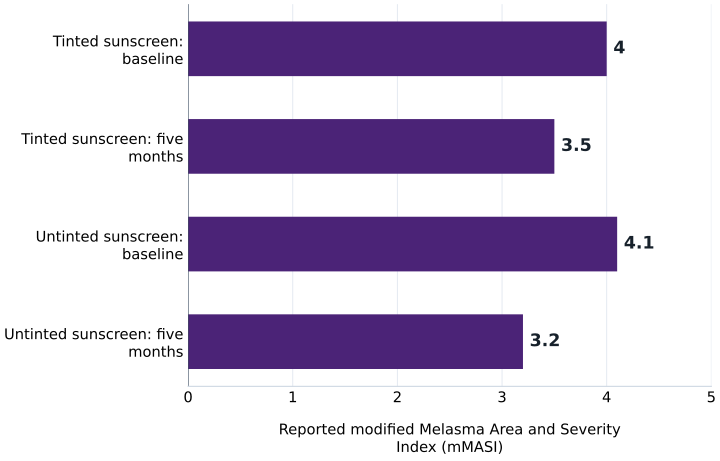
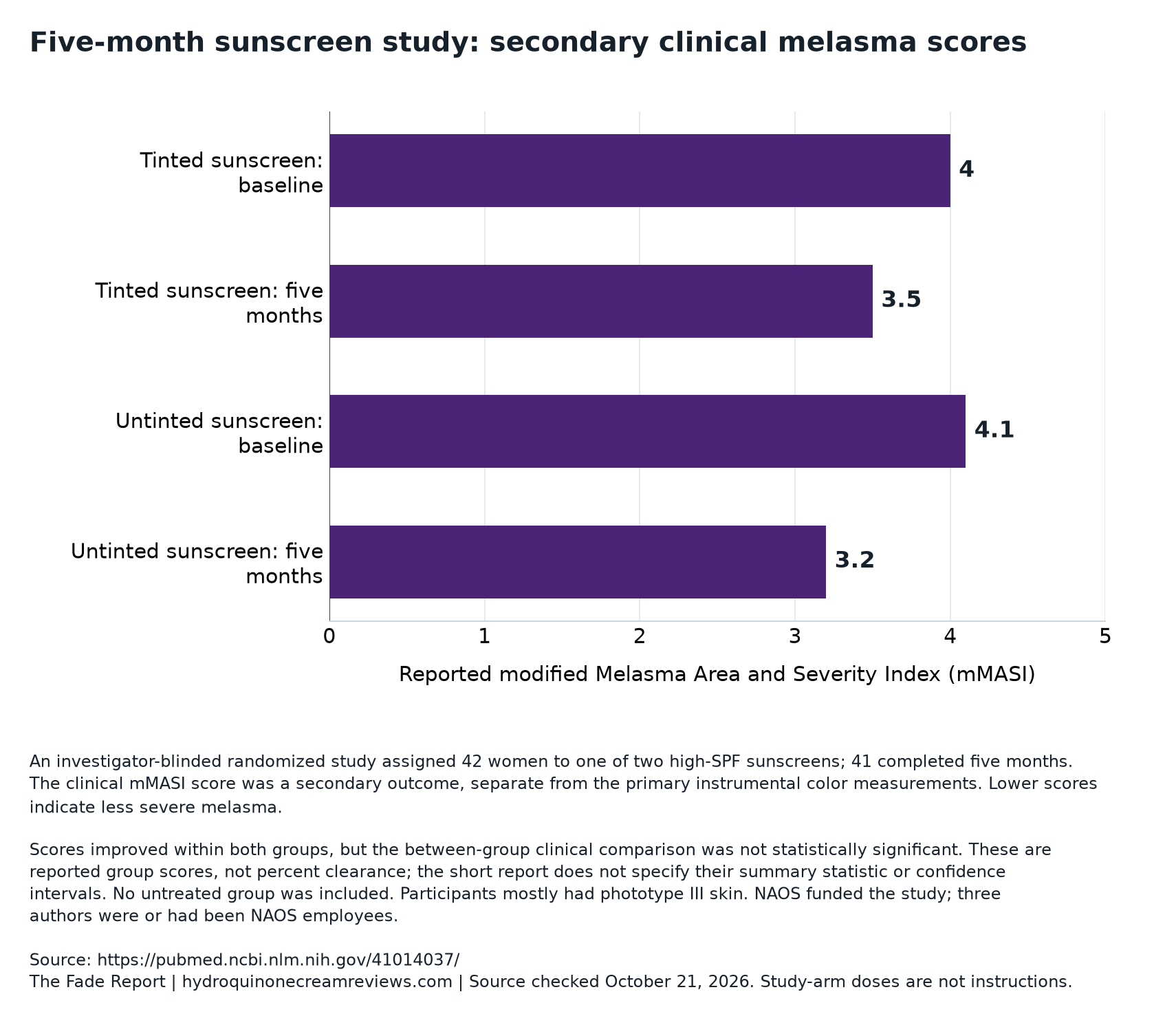
Both within-group P values were <0.001; the between-group clinical comparison was nonsignificant. The table names the clinical endpoint, its observation times and its score units. The values should be read with that context, rather than treated as percentages or as evidence that one preparation produced superior clinical results.
A group score does not supply the number of people who met a response threshold. That requires a definition of response and individual observations classified under it. Different distributions of individual outcomes can produce similar group summaries, so a pair of reported values cannot reveal how uniform the participants’ experiences were. A clearer chart cannot restore data that the displayed summary does not contain.
Our guide to interpreting clinical success percentages provides further context for this distinction. In the present interpretation, the chart’s purpose is to preserve the numerical record without assigning an unsupported summary statistic or personal prediction. A score change can be discussed as a score change. Deciding whether it represents a meaningful clinical benefit, a responder proportion or a comparative advantage requires the corresponding evidence and analysis, rather than a more expansive label for the same numbers.
Modified Melasma Area and Severity Index (mMASI) group scores, a secondary outcome. The summary statistic is unspecified.
| Preparation | Baseline score | Five-month score |
|---|---|---|
| Tinted | 4.0 | 3.5 |
| Untinted | 4.1 | 3.2 |
An official-looking citation cannot remove statistical uncertainty
Baseline measurements differed, and the experiment had no untreated group. Those design features affect different inferences: the starting position matters for interpreting change, while a missing untreated comparison limits what can be learned about an unobserved course without either product. A document’s formal appearance does not change those boundaries.
Within-group tests and between-group tests also have different targets. Evidence that one group changed does not establish that its treatment outperformed another. Nor does a significant change in one group and a nonsignificant change in another amount to a direct test of their difference. The comparison needs an appropriate estimate and an account of uncertainty, such as a confidence interval relevant to that estimate.
Our reading uses the full short report without reconstructing numerical plot effects or confidence intervals; its supplement has not been independently examined here. Those limits remain regardless of how strongly an article’s conclusion is worded. Establishing equivalence would likewise require a suitable design and an acceptable difference defined in advance. It cannot be inferred simply because an ordinary comparison fails to demonstrate superiority or because both products appear in a published research record.
The Chinese cream experiment remains a separate research record
The Chinese triple-combination study randomized 53 people and analyzed 52 in its modified intention-to-treat population. Its eight-week primary response was a two- or three-grade decrease on the Melasma Severity Scale: 12/23 for the generic preparation, 12/21 for Tri-Luma and 0/8 for vehicle. These figures describe that criterion, not complete clearance.
The companion analysis of the eight-week trial examines that comparison in detail. Its generic preparation is a product studied in a specific research context. A clinical comparison in China is not evidence of US approval of the tested generic. Similarly, an observed response to one preparation does not document the identity or regulatory status of a different product offered elsewhere.
The scientific lesson is to retain both the treatment identity and the outcome definition. A percentage can be accurately calculated and still be misapplied if either changes in the retelling. Comparing improvement with clearance also changes the question, even when the condition and one treatment name recur across documents. Our interpretation keeps the research result available for its intended comparison while requiring separate support for claims about another preparation or its place in a regulatory system.
The prescription label identifies a complete medicine and purpose
Tri-Luma labeling identifies hydroquinone 4%, tretinoin 0.05% and fluocinolone acetonide 0.01%. Its indication is short-term treatment of moderate-to-severe facial melasma with sun-avoidance measures, not maintenance. The label trials used cleared, or a Melasma Severity Scale score of zero, as their success criterion. Those details belong to the named medicine.
The guide to hydroquinone, tretinoin and steroid combinations helps readers keep a complete prescription formula visible. Our interpretation is that a familiar active ingredient should not stand in for the entire labeled preparation. The label’s purpose, safety information and trial record should remain attached to its actual identity, rather than being generalized to every cream with one ingredient in common.
This distinction also prevents a research observation from becoming a personal instruction. A study endpoint describes what investigators evaluated; labeling supplies another record that a clinician must consider in the relevant context. Neither authorizes this article to select a regimen for an individual. The useful contribution of an evidence review is to clarify which claim each record supports, so the next clinical question can be asked with the product, purpose and remaining uncertainty clearly identified.
Safety information should retain its source and scope
Both sunscreens were described as well tolerated; comparative adverse-event counts were unreported. Three authors disclosed current or former NAOS employment; Thierry Passeron disclosed industry honoraria. The study’s funding is identified in the key facts. These statements describe different parts of its record: the safety reporting and the relationships around the research. One cannot substitute for the other.
The Chinese trial separately reports support from the Scientific Research Fund of Zhejiang Provincial Education Department and Zhejiang Fonow Medicine, including manufacturer-supplied products; its authors declared no conflicts. The Tri-Luma label, meanwhile, warns about irritation, hypersensitivity, ochronosis and possible systemic corticosteroid effects. Those warnings should not be presented as sunscreen events or assigned to a different study’s sponsor.
Our safety interpretation asks what was observed, how it was collected and which preparation it concerns. A general tolerance description does not provide an incidence rate or establish the absence of rare harms. A warning identifies a concern but does not automatically quantify its frequency in every setting. Funding disclosures support scrutiny of methods and completeness; they are not themselves outcome data. Keeping these distinctions explicit helps prevent unrelated safety information from being combined into a misleading impression of either reassurance or danger.
The FDA notice answers a different product question
FDA states that OTC hydroquinone skin-lightening products lack approval for safety and effectiveness and cites reports of rash, facial swelling and potentially permanent ochronosis. That notice is distinct from the approved prescription Tri-Luma record. It does not determine the status of an unspecified compounded preparation or establish mercury contamination in an untested product.
Our editorial interpretation is to trace each current offer to its own documentation. Reviews of Nurx and RedBox Rx can help readers inspect the relevant product and service terms. These links do not imply that either provider supplied the sunscreen studied, participated in the research or delivers outcomes matching the trial. Documentary clarity and clinical evidence remain separate parts of the assessment.
The practical question is which record would resolve the uncertainty. A question about what was measured belongs with the research methods and results. A question about the named medicine’s indicated use belongs with its labeling. A question about a current offer requires documentation for that offer. The Fade Report uses those distinctions to make the evidence more usable, without converting a citation into a guarantee about a preparation, a provider or an individual’s response.
Questions about the evidence
Does a published study establish a product’s FDA approval?
Publication and approval are different claims. A research report can support statements about its experiment, while an approval claim needs the appropriate product-specific regulatory record. Our interpretation checks each claim against the kind of document capable of supporting it, rather than treating a citation as general authorization.
Why retain the exact sunscreen identity when discussing a result?
The comparison depends on what was actually tested. Another preparation may differ in ways relevant to the measured property or clinical outcome. A transfer of evidence therefore needs a supported connection between products, rather than an assumption based on a shared category or a similar name.
Can instrumental color improvement be described as clinical clearance?
That description requires evidence connecting the measurement to a defined clinical state. An observation about the difference between skin areas has its own meaning. Our methodological interpretation preserves that meaning and treats clearance as a separate endpoint, rather than an interchangeable label for a favorable change.
What does a nonsignificant comparison leave unresolved?
It may leave uncertainty about the magnitude of a difference that the study could not establish. It does not, by itself, prove equivalence. That stronger inference needs a design and analysis suited to an acceptable range of differences, with enough precision to assess that range.
How can a provider review use these records responsibly?
Our editorial approach separates documented offer terms from the scientific and regulatory records. A review can identify useful questions about the exact product while avoiding claims that an unrelated trial verifies a service’s efficacy or that one medicine’s label covers every preparation with a similar ingredient.
Source 4 Source 3 Source 1 Source 2
What this evidence supports
A clear reading gives each record a specific job. Research identifies an experiment and its measured results; labeling identifies a medicine and the boundaries of its indicated use; a regulatory notice addresses a particular concern. Our assessment is that the strongest explanation preserves those functions while showing how they inform the same clinical discussion. That allows useful findings to remain visible without turning an outcome measurement into an approval claim, transferring a label to a different preparation or treating a documented commercial offer as proof of clinical performance.
Research access and limitations
This analysis uses the full sunscreen short report and funding footnote, the separate Chinese cream trial, official Tri-Luma labeling and FDA’s consumer notice. Sunscreen supplementary methods and numerical plot estimates were not independently examined. The interpretation does not reconstruct missing confidence intervals, establish approval of another product or infer an individual treatment plan.